
Hybrid solar with battery backup in Phuket
— power through outages
Grid-tied solar goes dark the moment the power cuts. A hybrid system with battery storage does not: it saves you money all day, stores the surplus for the evening, and keeps your fridge, Wi-Fi and lights running automatically when the PEA grid drops. We design and install these systems across Phuket, Phang Nga and Krabi.
A hybrid system = solar panels + battery + smart hybrid inverter. By day it powers your home directly from the sun and cuts your PEA bill. Excess production charges the battery instead of being wasted, so you keep using solar power into the evening. And when the grid fails, the inverter switches to its built-in off-grid mode automatically and keeps your essential circuits running from the battery and panels — no manual switching, no generator noise. Typical payback in Phuket is around 4–7 years, and we start every project with a free site survey and a written savings estimate.
Why Phuket homes want backup power
Anyone who has spent a storm season on the island knows the pattern: brownouts when the grid sags, and outages when monsoon squalls bring lines down. For some households that is a nuisance; for others it is a real cost.
What actually happens when the grid fails
This is the part most people are surprised by: a normal grid-tied solar system shuts itself off during a blackout, even at midday. That is a mandatory safety feature (anti-islanding) that protects utility crews working on the lines. Panels alone will not keep your lights on.
A hybrid system behaves differently. The Deye hybrid inverters we install have an off-grid mode built in: when the grid drops, the inverter disconnects from the PEA network and continues supplying your connected loads from the battery — and from the panels too, if the sun is up. The switchover is automatic; you do not flip anything. The platform is also rated to deliver up to 2× its rated power for 10 seconds in off-grid mode, which covers the start-up surge of a water pump or air-conditioner compressor.
Good backup design is really essential-loads design. During installation we split your switchboard so the circuits that matter — refrigeration, internet, lighting, selected sockets, perhaps one aircon — sit on the backed-up side, while heavy discretionary loads (water heaters, the full aircon bank, pool heating) stay grid-only. That keeps the battery bank affordable and makes backup time predictable. When the grid returns, the system re-synchronises and goes back to normal solar-saving operation on its own.
On-grid vs hybrid vs off-grid — which fits Phuket?
For most Phuket villas and homes the grid is present but imperfect — which is exactly the scenario hybrid was designed for. You stay connected to PEA for cheap bulk power at night, harvest the sun by day, and hold a battery reserve for when the grid lets you down. If you are also interested in exporting surplus to the grid, see our guide to selling electricity back to PEA in Thailand.
How big a battery do you need?
Size the battery around your evening consumption in kWh — roughly, everything you use between sunset and bedtime, plus what must survive an outage overnight.
A practical way to think about it: list the loads you want covered (fridge ~1–2 kWh per day, router and lights well under 1 kWh, one inverter aircon 0.5–1.5 kWh per hour depending on size and settings), decide how many hours of autonomy you want, and add headroom so the battery is not cycled to empty every night. With Phuket averaging 4.5–5 peak sun hours per day, the panels have plenty of energy to both run the house and recharge the bank before evening.
We install LVTOPSUN LiFePO4 battery modules — the lithium iron phosphate chemistry that has become the standard for home storage thanks to its long cycle life and thermal stability. The modules are scalable: they connect in parallel, so you can start with a bank sized for essentials and add capacity later as your needs (or your household) grow. During the free survey we review your PEA bills and evening usage pattern and put a concrete kWh recommendation in the written quote.
The hybrid equipment we install — on real Phuket roofs
The heart of our hybrid installations is the Deye SUN-20K three-phase hybrid inverter (20 kW output, up to 40 kW of panels, 48V battery bus with up to 350A charge/discharge, parallelable up to 10 units, IP65). Full specifications are on our Deye SUN-20K page — the page is in Thai, but the manufacturer's English datasheet PDF is downloadable there. Smaller single-phase homes get a proportionally sized hybrid inverter from the same platform.
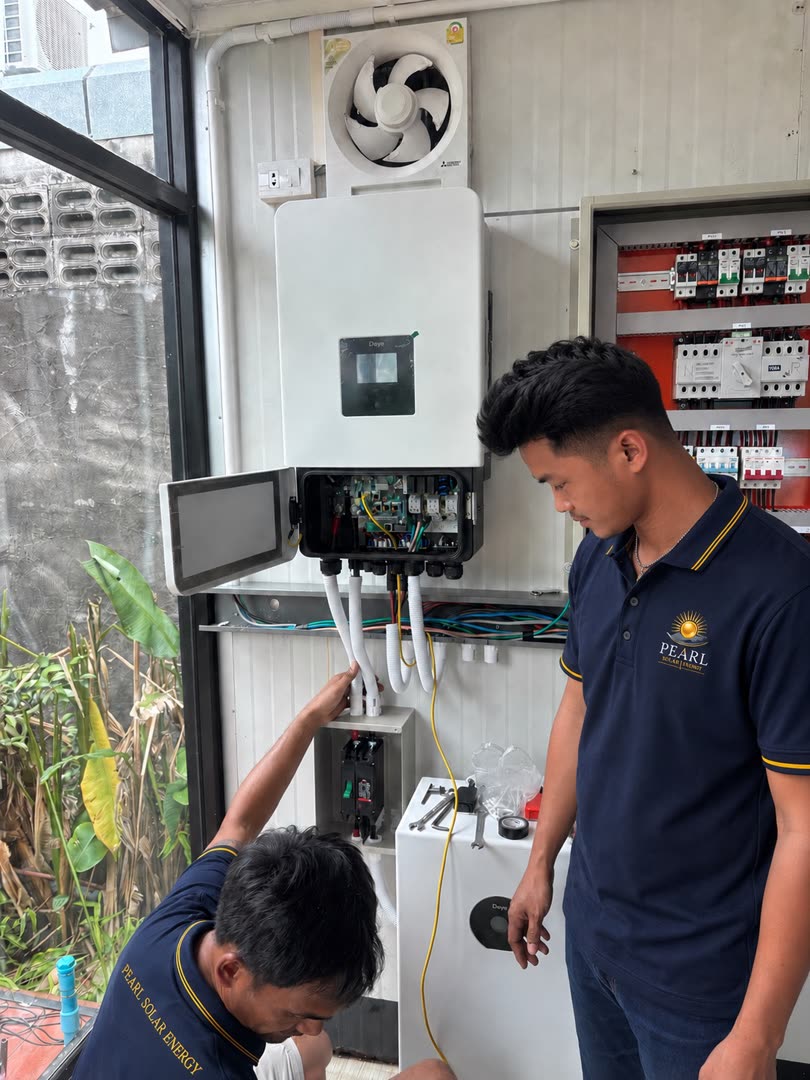
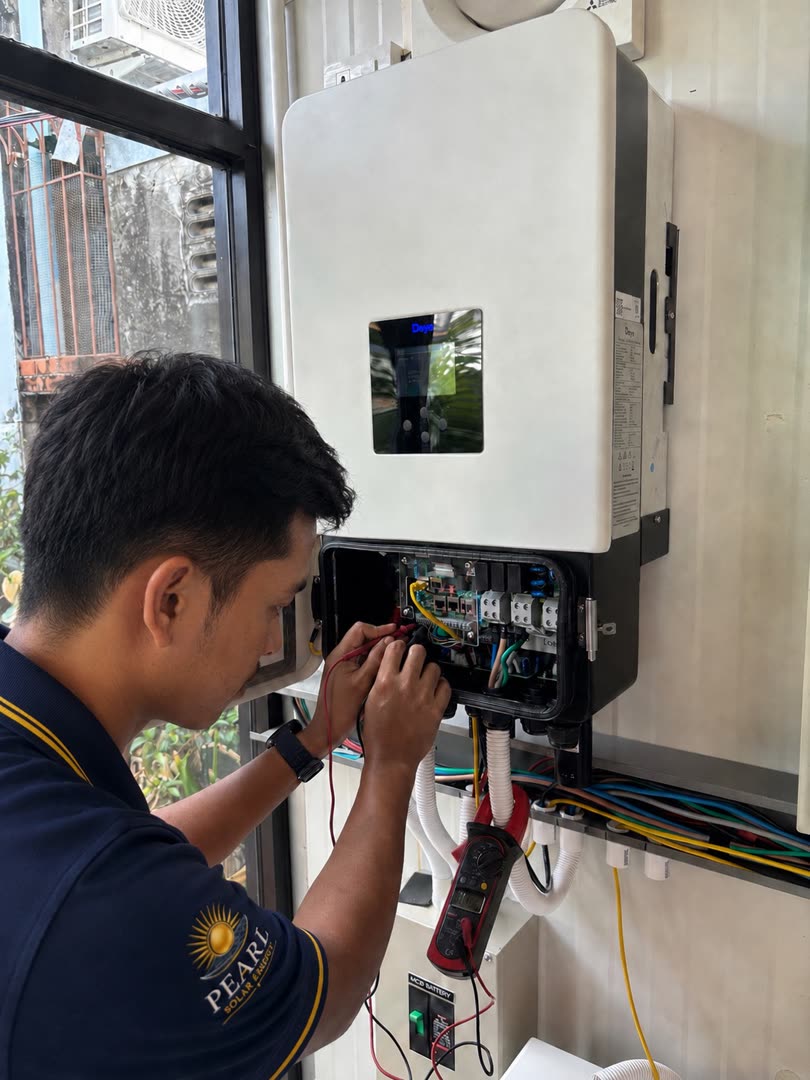
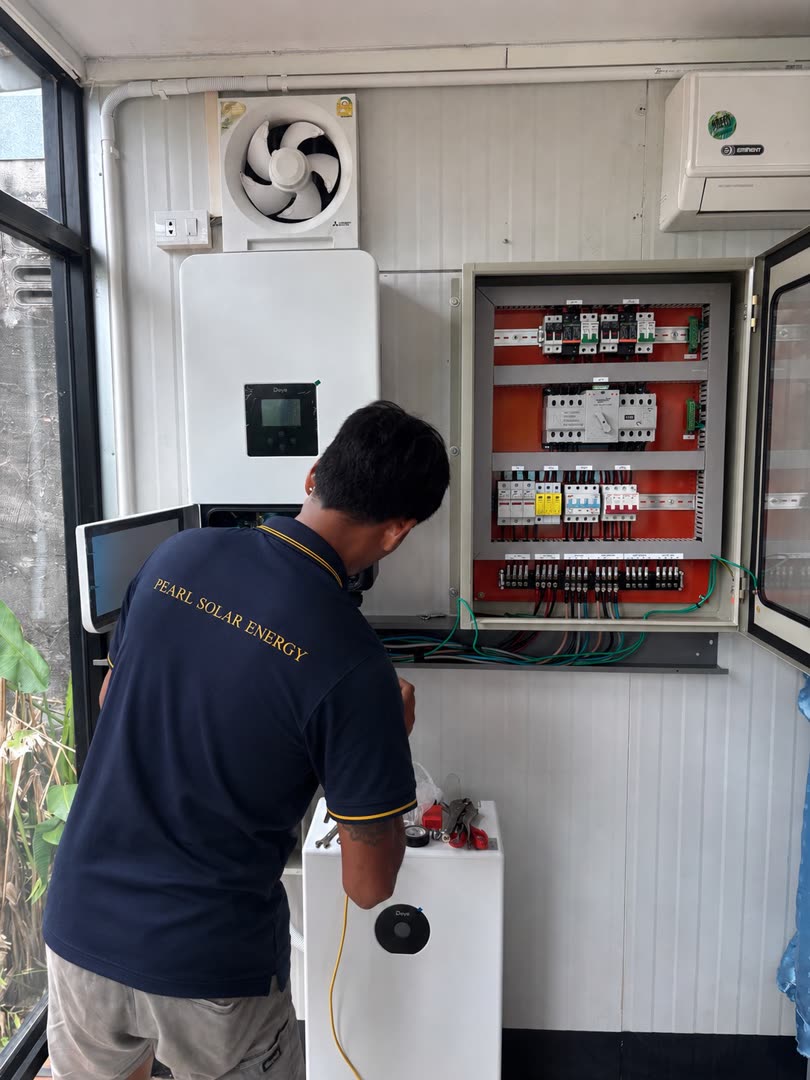
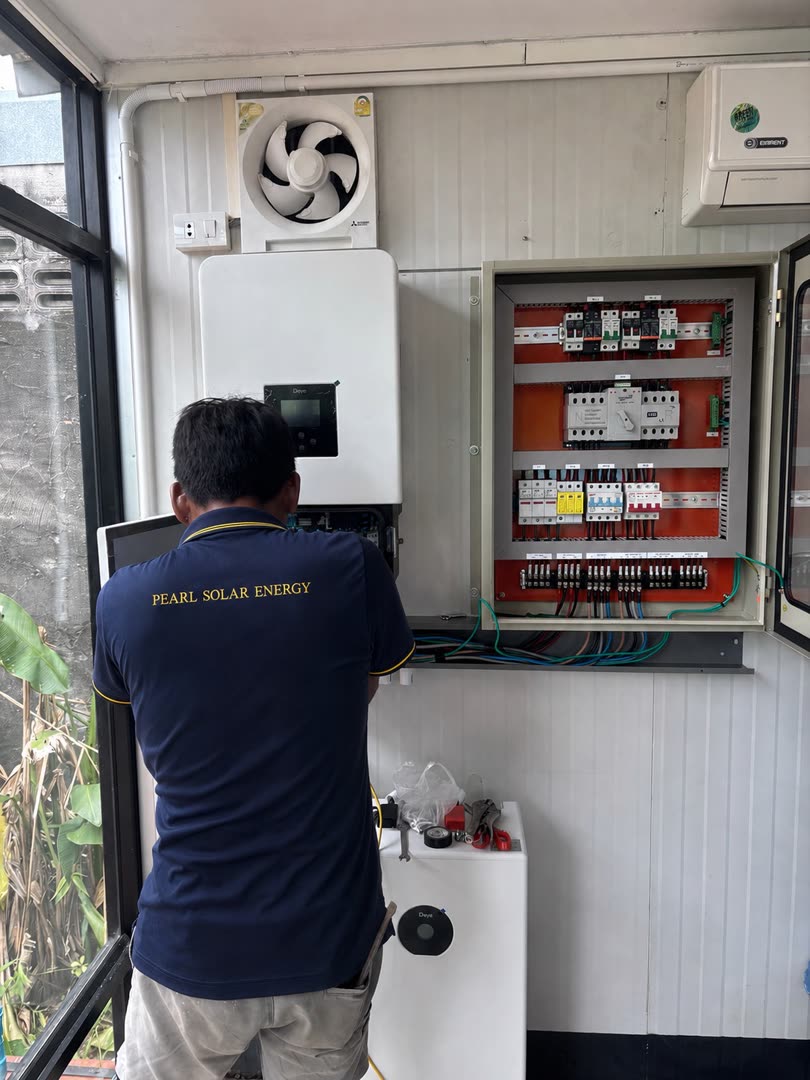
More photos from this job are on our projects page. Panels carry 25–30 year performance warranties from Tier-1 manufacturers; inverter and battery warranty terms are confirmed per model in your written quote.
Battery backup questions we hear most
Does solar work during a blackout without a battery?
No. A standard grid-tied (on-grid) solar system must shut down automatically when the grid fails — a safety requirement called anti-islanding that protects utility workers repairing the lines. Even in full sunshine, your panels produce nothing during an outage. A hybrid system with a battery is different: its inverter has a built-in off-grid mode, so it disconnects from the grid and keeps powering your essential circuits from the battery and panels.
How long can a battery run my house during an outage?
It depends on the battery capacity (kWh) and what you keep running. A typical essential-loads setup — fridge, freezer, Wi-Fi, lights, fans and a few sockets — draws far less than the whole house, so even a modest battery bank can carry it for several hours, and through the night with a larger bank. If the outage happens in daylight, the panels recharge the battery at the same time, extending backup further. We size the battery around your actual evening consumption during the free site survey.
Can I add more batteries later?
Yes. The LiFePO4 battery modules we install are modular and designed to be connected in parallel, so you can start with a smaller bank and expand as your needs grow. The Deye hybrid inverter platform supports high battery charge/discharge current and multiple battery modules in parallel, and the inverters themselves can be paralleled if you later need more output power. We recommend planning cable routes and wall space for expansion during the initial installation.
How long do solar batteries last, and what is the warranty?
The LiFePO4 (lithium iron phosphate) chemistry we install is the long-life standard for home storage — this class of battery is generally rated in the thousands of charge cycles (around the 6,000-cycle class for quality modules), which typically translates to roughly a decade or more of daily use. Exact cycle ratings and warranty terms vary by model and manufacturer, so we confirm the specific figures in writing for the exact battery model in your quote rather than promising a blanket number.
Do hybrid systems need much maintenance?
Very little. LiFePO4 batteries are sealed and maintenance-free — no fluid top-ups, unlike old lead-acid banks. The routine care is the same as any rooftop solar system in Phuket: periodic panel cleaning (salt spray and dust reduce output), a visual check of cabling and breakers, and monitoring via the inverter app, which will flag most issues remotely. We offer maintenance and cleaning packages, and the battery management system protects the cells automatically in daily operation.
Own a pool villa? See our dedicated guide to solar for pool villas in Phuket, or if your property is up the coast, solar in Khao Lak & Phang Nga. For everything else about going solar on the island, start at our English home page.
Never sit through another blackout
Book a Free Site Survey — written savings estimate in THB, battery sizing included. Call, message us on LINE, or email — we reply in English. No obligation.
Pearl Solar Energy Co., Ltd. · 19/27 Moo 2, Wichit, Mueang Phuket, Phuket 83000 · Mon–Sat 08:00–17:00